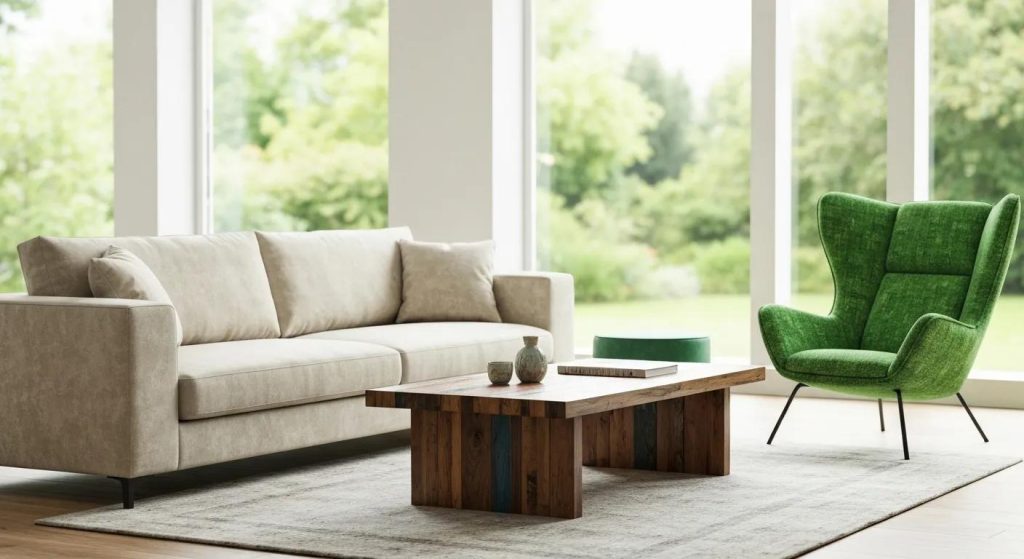
Eco-friendly refurbished furniture — benefits for your home
Refurbished furniture means pre-owned or salvaged wooden pieces that have been repaired, restored or upcycled so they last longer — without the energy‑heavy processes of new manufacture. By cutting the need for fresh timber, factory production and long-distance shipping, refurbished items carry far less embodied energy and help lower a household’s carbon footprint. This guide shows where energy is saved, gives typical savings ranges, and highlights environmental and health co‑benefits — for example, improved indoor air quality from low‑VOC finishes and resource conservation via reclaimed timber. You’ll find practical buying and selection tips, clear embodied‑energy comparisons, and circular‑economy guidance for choosing genuinely low‑energy furniture. Where relevant, we point to local options in Harrogate so you can turn sustainability intent into straightforward, low‑energy choices for your home.
How much energy can you save by choosing refurbished furniture?
Refurbished furniture reduces energy mainly by avoiding the embodied energy of new production, shortening transport through local refurbishment and resale, and extending a piece’s service life so its annual energy footprint falls. The embodied energy for new furniture includes timber extraction, milling, manufacturing, finishing and global logistics — steps you largely avoid when a piece is repaired or reused. Choosing refurbished wooden furniture therefore lowers demand for new manufacturing and spreads embodied energy over many more years, which reduces the average annual energy tied to household furnishings. Below is a concise comparison that illustrates typical, order‑of‑magnitude differences between new and refurbished options to help with practical decisions.
Furniture lifecycle energy comparison (new vs refurbished):
| Item type | Energy in manufacture & transport | Relative annual energy (per 10 years) |
|---|---|---|
| New solid-wood wardrobe | High — raw timber milling, factory finishing, long transport | High annualised embodied energy |
| Refurbished solid-wood wardrobe | Low — local repair/refinish, reused structure | Much lower annualised embodied energy |
| New kitchen unit (virgin materials) | Very high — complex manufacture, fittings, long supply chains | Very high annualised embodied energy |
How does refurbishment cut manufacturing and transport energy?
Refurbishment sidesteps the most energy‑intensive stages of production: harvesting virgin timber, primary processing (sawmilling, drying), large‑scale component fabrication and factory finishing. Repair work focuses on joinery, surface treatment and replacing hardware — tasks that use far less energy than full new manufacture. Transport energy falls when pieces are sourced, refurbished and sold locally, avoiding long‑haul freight and multi‑stage logistics typical of factory‑made furniture. For example, restoring an oak dresser usually uses only a fraction of the energy needed to fell, mill, kiln‑dry, assemble and ship a new equivalent. Knowing which stages are avoided helps you prioritise the choices that maximise energy savings.
What percentage of energy can you save with refurbished wooden furniture?
Savings vary by item, the extent of refurbishment and transport distance, but lifecycle studies commonly show refurbishing or reusing furniture can save roughly 50%–90% of embodied energy compared with new pieces made from virgin materials in many scenarios. Smaller items or light reconditioning trend toward the higher end, while heavy reworks still deliver meaningful reductions compared with full new manufacture. Factors that influence the percentage include whether reclaimed wood replaces virgin timber, the distance materials travel and the carbon intensity of local electricity used in refurbishment. Treat these ranges as directional guides when deciding whether to refurbish, buy refurbished or commission bespoke upcycling.
Embodied Energy: Refurbishment vs. Demolition for Homes
The original house was used as a benchmark to compare embodied energy in new construction against refurbishment options. Analysing embodied energy for new builds and refurbishment is complex and requires careful accounting of materials and processes involved.
Embodied energy on refurbishment vs. demolition:
A southern Europe case study, PL Gaspar, 2015
What environmental benefits come from sustainable refurbished wooden furniture?
Sustainable refurbished wooden furniture delivers benefits beyond energy savings: it reduces landfill, conserves timber resources and lowers lifecycle carbon emissions. Keeping furniture in use through repair, remanufacture or upcycling means fewer materials are thrown away and fewer virgin trees are needed, easing pressure on forests and biodiversity. Lower manufacturing throughput also cuts industrial emissions across supply chains. Below is a focused comparison of reclaimed wood and virgin timber to show energy and resource advantages in simple terms.
Reclaimed wood energy and resource comparison:
| Material source | Typical embodied energy | Approximate % energy saved vs virgin |
|---|---|---|
| Virgin timber (new) | High — harvesting, processing, finishing | Baseline (0%) |
| Reclaimed timber | Low — reused structure, minimal processing | Up to ~90% energy saved |
| Recycled composite (e.g., reconstituted board) | Medium — reprocessing energy | Varies; often less than virgin but higher than reclaimed |
How does refurbishment lower carbon footprint and reduce waste?
Refurbishment reduces embodied carbon by avoiding new manufacture and prevents methane and CO₂ releases from landfill. Extending a piece’s useful life spreads its embodied carbon across more years, lowering annualised emissions — adding five to ten years, for example, can substantially cut a piece’s yearly footprint versus frequent replacement with mass‑produced items. Waste diversion is measurable too: reused or remade furniture reduces bulky waste volumes that require energy‑intensive collection, transport and disposal, further lowering greenhouse gas emissions from end‑of‑life management.
Embodied Energy in Office Furniture, Fixtures, and Fittings
This paper looks at the embodied energy of fixtures, fittings and furniture in office buildings and compares it with other building elements, showing how demand for new items adds to indirect embodied energy in construction materials.
Embodied energy analysis of fixtures, fittings and furniture in office buildings, PED Love, 1999
How does using reclaimed wood help conserve resources?
Reclaimed wood conserves resources by diverting timber from waste streams and reducing demand for fresh logging, helping protect forests and biodiversity. Common sources include deconstructed buildings, salvaged beams and surplus offcuts — often needing only cleaning, planing and finishing before reuse. Reclaimed timber saves a large share of embodied energy versus virgin wood because the most energy‑intensive processing has already taken place in an earlier life. Beyond ecological gains, reclaimed wood adds character and heritage value, which encourages longer care and therefore amplifies its resource‑saving effect.
How does the circular economy apply to furniture and energy savings?
The circular economy for furniture follows practical principles — design for longevity, repair and refurbishment, reuse and resale, and material recovery — to cut energy use and emissions across a product’s life. In practice this means favouring solid wood and repair‑friendly joinery, using low‑VOC finishes that allow safe maintenance, and building local refurbishment networks that keep furniture in use. Each principle reduces demand for new production and therefore saves the embodied energy that would otherwise be spent on replacements. The list below summarises circular actions homeowners and local providers can adopt to get the most energy savings from furniture systems.
- Design for Durability: Choose or commission pieces with solid joinery and replaceable parts so they last longer.
- Repair & Refurbish: Prioritise repair over replacement — targeted refurbishment preserves structure and cuts energy use.
- Reuse & Resell: Use local resale and exchange networks to keep pieces circulating in the community.
What are the circular‑economy principles for furniture refurbishment?
Applied to furniture, circular principles mean repairing instead of discarding, upcycling elements into new forms, designing for disassembly so parts can be recovered, and using reclaimed materials in new commissions. Repair focuses on structural fixes and re‑finishing rather than replacement; upcycling repurposes components into higher‑value items; design for disassembly speeds material separation for future recycling. Local refurbishment networks put these ideas into practice by keeping transport short and sustaining local skills for long‑term maintenance. Together these approaches lower energy demand across production, transport and waste handling.
How does circular‑economy furniture reduce greenhouse gas emissions?
Circular furniture lowers greenhouse gases mainly by cutting the volume of new production and extending product life, which dilutes embodied emissions. Less new manufacturing means less fossil‑fuel energy in factories and fewer emissions from raw‑material extraction and processing. Projected at scale, increased rates of reuse and refurbishment in consumer goods deliver notable GHG reductions — and for households, choosing refurbished over new is a direct, practical climate action.
Refurbished vs. New Buildings: Carbon Footprint & Cost Analysis
This study compares refurbishment with replacement for residential archetypes in London, examining life‑cycle carbon footprints and costs. Results show that many refurbishment options offer clear environmental benefits over new construction.
Refurbish or replace?
The life cycle carbon footprint and life cycle cost of refurbished and new residential archetype buildings in London, Y Schwartz, 2022
What practical benefits do refurbished pieces bring for homeowners?
For homeowners, refurbished furniture delivers immediate cost savings, greater longevity thanks to traditional joinery, and health benefits when low‑VOC finishes and solid wood are chosen. Upfront prices are generally lower than new bespoke or factory options, and repairability means many refurbished pieces are better value over the long term. Health improvements arise because solid‑wood pieces finished with low‑VOC products avoid the formaldehyde‑rich composite boards found in some new items. Below is a short list to frame the homeowner advantages when you’re comparing options.
- Cost‑efficiency: Lower purchase price and fewer replacements save money over time.
- Durability & Repairability: Traditional joinery and solid timber make repairs straightforward and extend useful life.
- Indoor air quality: Low‑VOC finishes and solid wood reduce off‑gassing risks compared with some manufactured boards.
How does refurbished furniture save you money vs new purchases?
Refurbished furniture saves both at purchase and over its life: repair is usually cheaper than wholesale replacement, and well‑restored items retain value longer. Typical savings vary by category — small items may cost 40–70% less than new equivalents, while larger bespoke projects that reuse existing materials can be especially good value versus commissioning new work. Ongoing savings also come from easier repairs: replacing a single component is far cheaper than buying a new piece. For homeowners balancing budget and sustainability, commissioning refurbishment or buying restored pieces is often the smartest value choice.
How does sustainable furniture improve indoor air quality and longevity?
Sustainable refurbished furniture can boost indoor air quality by replacing worn or high‑emission parts and using low‑VOC finishes and adhesives during refurbishment. Solid wood pieces finished with water‑based paints or natural oils off‑gas far less than many engineered boards that contain formaldehyde or solvent‑based adhesives. Durability comes from robust materials and traditional joinery, allowing multiple repair cycles that keep items out of the waste stream and reduce frequent, energy‑intensive replacements. Prioritise clear low‑VOC finishing choices and check joinery to meet both IAQ and longevity goals.
How do you choose eco‑friendly finishes and materials for refurbished furniture?
Picking eco‑friendly finishes and materials is key to making sure refurbishment delivers energy and health benefits. Choose water‑based paints and lacquers, natural oils or wax finishes, and adhesives certified for low emissions to cut indoor pollution and protect the gains of reuse. Avoid high‑VOC solvent‑based products and formaldehyde‑containing boards so air quality and circular goals aren’t undermined. The table below compares common finish types and their main attributes to help homeowners and refurbishers decide.
Intro: The table summarises sustainable finish options, their trade‑offs in durability and VOC level, and the typical benefits they deliver at home.
| Finish type | Key attribute | Benefit |
|---|---|---|
| Water-based paint | Low VOC, fast drying | Good colour range, lower indoor‑air impact |
| Natural oils (linseed, tung) | Penetrating, minimal VOC | Enhances grain; simple maintenance |
| Beeswax or wax blends | Low chemical load | Natural sheen; easy spot repair |
| Low-VOC lacquer | Durable, lower emissions | Longer‑lasting protection with controlled VOCs |
Which sustainable finishes and low‑VOC materials work best?
The best choices balance low emissions with durability: quality water‑based paints and clear lacquers give durable protection with limited VOCs, while plant‑based oils and beeswax keep chemical load minimal and suit decorative or lightly used pieces. Look for products labelled low‑VOC or suitable for indoor furniture; clear ingredient lists and certifications build confidence without needing brand names. Good maintenance — gentle cleaning and periodic oiling — extends finish life, cutting the need for rework and conserving energy. The right finish depends on the piece’s use and your household’s indoor‑air priorities.
How do upcycling and reclaimed wood increase environmental savings?
Upcycling and reclaimed wood raise environmental savings by avoiding extra processing and by turning materials that might be discarded into valued pieces that last longer. Upcycling might turn tabletop timber into shelving or old doors into cabinetry, creating higher‑value uses that extend the material lifecycle and lower demand for new timber. These creative routes typically use little extra material and energy compared with full manufacture, delivering substantial net savings in embodied energy. Many buyers also choose upcycled pieces for their uniqueness, which encourages long‑term use.
Where can you find sustainable refurbished furniture locally in Harrogate?
Seeing pieces in person makes it easier to check materials, finishes and workmanship, and sourcing locally cuts transport‑related energy. In Harrogate, a nearby specialist offers a combined shop and warehouse where you can view refurbished wooden items, discuss bespoke commissions and explore remodelling options. Visiting the workshop lets you inspect joinery, talk through low‑VOC finishes and get tailored advice on upcycling existing pieces to maximise material and energy efficiency. The next section outlines services from a local, permitted provider and practical benefits of an in‑person visit.
What services does Sustainable Refurbished Furniture By HDS offer in Harrogate?
Sustainable Refurbished Furniture By HDS runs a local shop and warehouse selling refurbished wooden furniture, taking bespoke commissions (hand‑painted tables, spray‑finished wardrobes) and offering a bespoke furniture remodelling service — with “Kitchens coming soon!” listed as an upcoming offering. Services include in‑person viewing and bespoke consultations, plus nationwide delivery if required, so customers can judge workmanship and choose low‑VOC finishes that support energy‑efficient outcomes. These local examples show practical ways to move from good intentions to a lower‑energy home interior.
How can visiting the Harrogate shop help you make energy‑efficient furniture choices?
Visiting in person lets you assess material quality, joinery and finishes up close — all key to energy and health outcomes — while staff can explain a piece’s refurbishment history and advise on low‑VOC options and upcycling ideas. When you visit, look for solid‑core construction, evidence of traditional joinery, the finish type used and any provenance documentation for reclaimed timber. A bespoke consultation can estimate the energy and material benefits of refurbishing an existing item versus replacing it. If you can’t visit, enquire about remote consultations to get tailored guidance on making energy‑responsible choices.
- In‑store inspection checklist: Confirm solid timber elements, check joinery quality and ask about finish types and care recommendations.
- Consultation benefits: Bespoke advice can tailor refurbishment to cut embodied energy and improve indoor air quality.
- Logistics: Buying locally or collecting items reduces transport energy; ask about nationwide delivery if you need it.
These practical steps turn the environmental advantages of refurbished furniture into real, energy‑efficient choices for your home. Sustainable Refurbished Furniture By HDS is at Unit 1B, Hollins Lane, Hampsthwaite, Harrogate HG3 2HL and offers viewing, bespoke commissions, remodelling services and nationwide delivery; Kitchens coming soon! Consider booking a consultation to explore options that reduce embodied energy, improve indoor air quality and support local craftsmanship.
Frequently Asked Questions
What is the lifespan of refurbished furniture compared to new furniture?
Refurbished pieces often last longer than many new items because they’re commonly made from solid timber and use traditional joinery. They’re also designed to be repairable, so regular maintenance and occasional repairs keep them in service for many more years. That longevity reduces waste and makes refurbished furniture a more sustainable long‑term choice.
How can I ensure the quality of refurbished furniture?
Check craftsmanship and materials: look for solid wood construction, traditional joinery and well‑applied finishes. Ask about the refurbishment steps taken, any repairs or treatments, and request photos or documentation where available. Visiting local workshops or stores is useful for direct inspection, and reviews or recommendations can help identify reputable refurbishers.
Are there specific styles of furniture that are better suited for refurbishment?
Pieces made from solid wood — such as mid‑century modern, antiques or traditional styles — tend to be excellent candidates for refurbishment because of their durable construction and timeless appeal. Simple, well‑built items are usually easier to update and adapt to modern tastes while keeping their structural value intact.
What are the health benefits of using refurbished furniture?
Refurbished furniture can improve indoor air quality when low‑VOC finishes and natural materials are used. Many refurbished pieces avoid the chemical loads found in some new products, such as formaldehyde and high‑VOC adhesives. Solid wood items generally off‑gas far less than engineered boards, helping create a healthier home environment.
How does the cost of refurbished furniture compare to new furniture?
Refurbished furniture is typically more affordable than new equivalents — often 40–70% cheaper for smaller items — because refurbishment costs are lower than full manufacture. Refurbished pieces also tend to hold value and are easier to repair, delivering further savings over the lifetime of the item.
Can refurbished furniture be customised to fit my style?
Yes. Many refurbishers offer bespoke services so you can choose finishes, colours and modifications that match your aesthetic. Whether you want a specific paint shade, different upholstery or design changes, a skilled refurbisher can adapt a piece to be both attractive and sustainable.
What should I consider when selecting eco‑friendly finishes for refurbished furniture?
Prioritise low‑VOC, water‑based products and natural oils or waxes that enhance the wood without harmful chemicals. Consider durability too — a longer‑lasting finish means less frequent reapplication and lower material use over time. Check for clear ingredient lists or certifications to ensure finishes meet your health and sustainability standards.
Conclusion
Choosing eco‑friendly refurbished furniture reduces your carbon footprint, supports resource conservation and can improve indoor air quality — all while saving you money. By selecting well‑finished, repairable pieces and prioritising low‑VOC options you turn good intentions into practical, low‑energy choices for your home. Explore local options for sustainable furniture today and take a straightforward step towards a more eco‑conscious home.